Traversal Functions
Traversal functions find the neighbours of a given cell — the cells that share an edge with it.
getNeighbours
Get the immediate neighbours of a cell at the same resolution.
getNeighbours(cell_id) → list[cell_id]
Returns: 6 neighbours for hexagons, 5 for pentagons. Invalid entries (for pentagonal exclusion zones) are marked with a sentinel value.
Python — geometry-based (dggrid4py)
For practical use, neighbour lookup via spatial index on a pre-generated grid is the most straightforward approach:
from dggrid4py import igeo7

# Pre-generate grid for your area of interest
gdf = dggrid.grid_cell_polygons_for_extent(
    "IGEO7", resolution=9, clip_geom=my_area,
    output_address_type="Z7_STRING",
)
sindex = gdf.sindex.query(gdf.geometry, predicate="intersects")

# Get neighbours of a specific cell
neighbours = igeo7.get_neighbours_by_z7(
    z7_idx="090264253",
    gdf=gdf,
    gpd_sindex=sindex,
    z7_col="global_id",
)
print(neighbours)
Julia — Z7 arithmetic (IGEO7.jl)
IGEO7.jl implements neighbour traversal directly via Z7 index arithmetic without any geometry:
using IGEO7

idx = z7string_to_index("0800433")
neighbours = get_neighbours(idx)
# Returns Vector{Z7IndexUInt64} with 6 entries
# Entries equal to typemax(UInt64) are invalid (pentagon exclusion)

valid = filter(n -> n.raw != typemax(UInt64), neighbours)
[index_to_z7string(n) for n in valid]
The Z7 Neighbour Algorithm
This section describes how Z7 neighbour traversal works. It is based on Renoud and Shaw's C++ prototype and the formal treatment in the IGEO7 paper.
Z7 neighbour traversal uses the Generalized Balanced Ternary (GBT) numeral system described in Lucas and Gibson (1982) and van Roessel (1988). Finding the neighbour in direction at resolution is equivalent to adding to the last digit using a GBT addition table, with carry propagation up through coarser resolutions.
Rotation Pattern
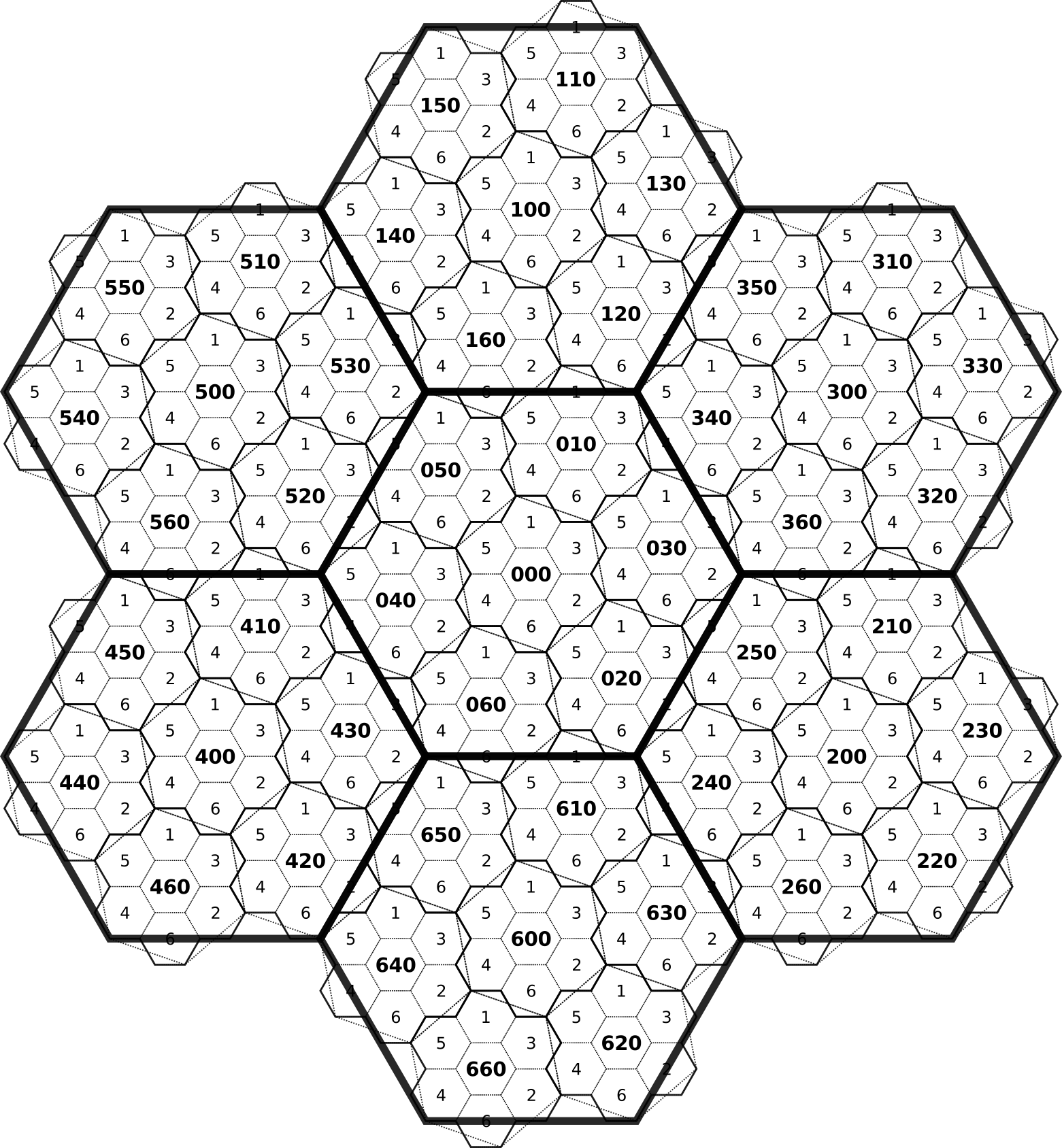
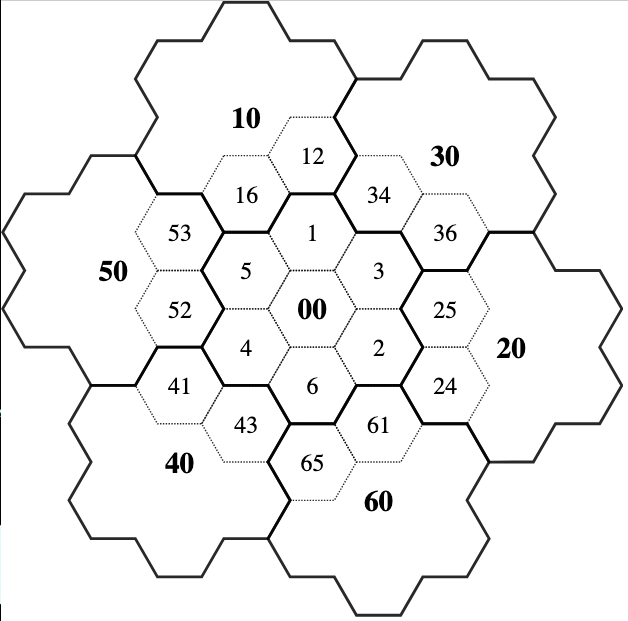
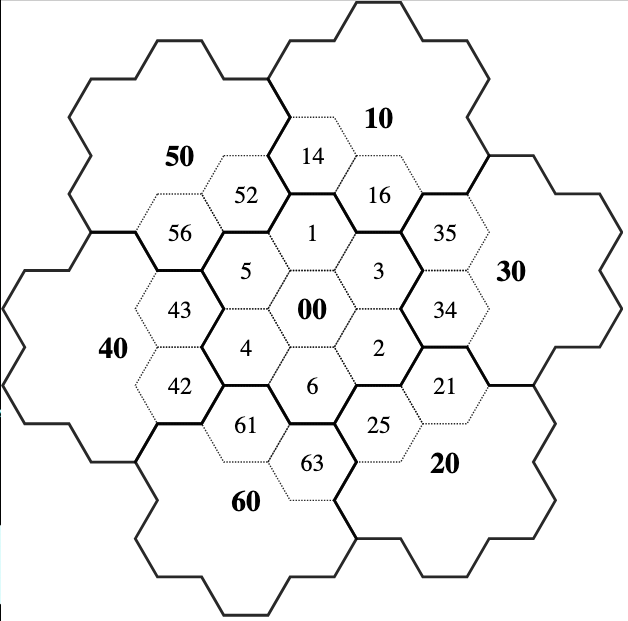
Lucas and Gibson (1982) gave examples of GBT with exclusively counter-clockwise (CCW) rotation. The disadvantage of this approach is that hexagon orientations at different hierarchy levels diverge from each other. White et al. (1992) proposed alternating rotation direction (CW, CCW, CW, …) to maintain alignment across levels. Kmoch et al. (2025) adopted this alternating pattern for Z7, assigning CW to odd resolutions and CCW to even resolutions.
GBT Addition Tables
The neighbour in direction from digit is computed by a 7×7 lookup table. Two tables exist — one for CW (odd) resolutions and one for CCW (even) resolutions:
| CCW (even resolutions) | CW (odd resolutions) |
|---|---|
 |  |
The full implementation, including carry propagation and cross-base-cell rotation handling, is in IGEO7.jl and the C++ prototype by Renoud and Shaw.
References
- Renoud, W. and Shaw, J. (2025). Z7. GitHub.
- Lucas, D., & Gibson, L. (1982). Automated Analysis of Imagery. Air Force Office of Scientific Research. (No. AFOSR-TR-83-0055).
- Sahr, K. (2011). Hexagonal discrete global grid systems for geospatial computing. Archives of Photogrammetry Cartography and Remote Sensing, 22, 363–376.
- van Roessel, J. W. (1988). Conversion of Cartesian coordinates from and to Generalized Balanced Ternary addresses. Photogrammetric Engineering & Remote Sensing, 54(11), 1565–1570.
- White, D., Kimerling, J. A., & Overton, S. W. (1992). Cartographic and Geometric Components of a Global Sampling Design for Environmental Monitoring. Cartography and Geographic Information Systems, 19(1), 5–22.